Lake Ridge began in 1969 as a planned community on the Occoquan Reservoir; its homeowners association was formed March 29, 1972. Markers and landmarks.
Last checked Oct. 19, 2026. Sources: the Lake Ridge Parks and Recreation Association’s About Us page, the National Park Service’s National Register of Historic Places data, Prince William County’s Office of Historic Preservation and the historical markers themselves. Dates are as those sources give them.
Lake Ridge is young by Virginia standards. It was planned and built from 1969 on the woods along the southern bank of the Occoquan Reservoir, and it has never been a town with its own government. The history around it is much older: the mill town of Occoquan next door, colonial houses along the Potomac and the road George Washington rode as a teenager.
Who to call
- Prince William County Office of Historic Preservation (Rippon Lodge, markers): 703-499-9812
- Occoquan Historical Society (Mill House Museum): occoquanhistoricalsociety.org, 413 Mill St., Occoquan
- Lake Ridge Parks and Recreation Association (community history): 703-491-2154
How Lake Ridge began
According to the Lake Ridge Parks and Recreation Association:
| Date | What happened |
|---|---|
| 1969 | Ridge Development Corp., with Kenneth Thompson, begins turning a remote cluster of homes into the planned community of Lake Ridge |
| March 29, 1972 | The Declaration of Covenants, Conditions and Restrictions is recorded in Prince William County, establishing the Lake Ridge Parks and Recreation Association |
| Today | 4,700 acres, with 1,200 acres of common ground kept by the association and 7,278 property units |
Lake Ridge was laid out as a planned unit development: neighborhoods of single-family homes, town houses and condominiums grouped around shared woods, trails, pools and lakes, with the association maintaining the common land. The association still runs those amenities and its own magazine, and it keeps a Lake Ridge Legacy page collecting residents’ stories and photographs.
Lake Ridge has never incorporated. For statistics, the Census Bureau treats it as a census-designated place; the 2010 census counted 41,058 people and the 2020 census 46,162. See our population guide.
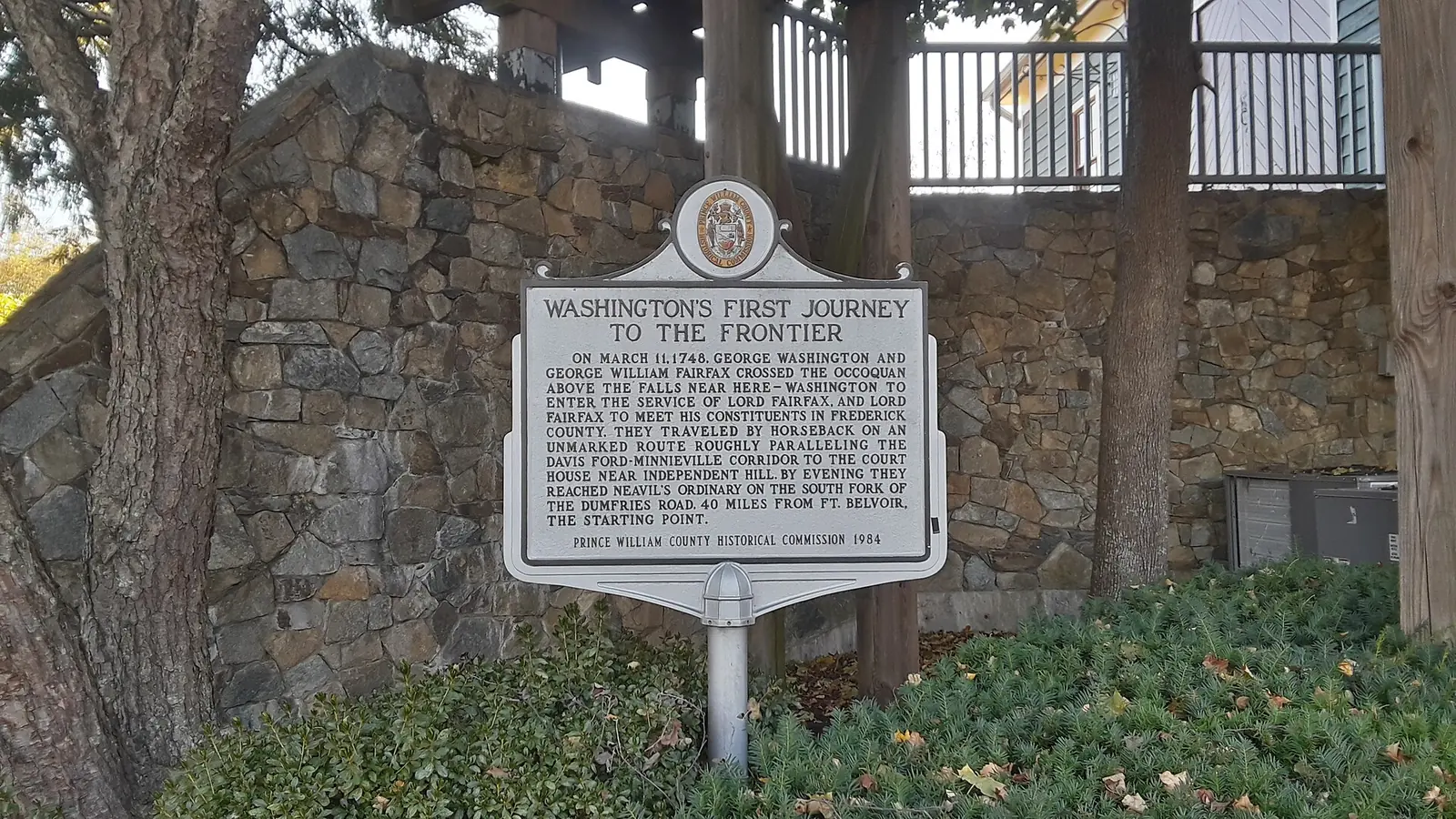
Washington’s First Journey to the Frontier
The earliest event recorded on a Lake Ridge marker is on the sign beside the Old Mill building at Tackett’s Mill. The Prince William County Historical Commission placed it in 1984. It reads, in part: on March 11, 1748, George Washington and George William Fairfax “crossed the Occoquan above the falls near here,” Washington to enter the service of Lord Fairfax. The two rode on an unmarked route roughly following today’s Davis Ford and Minnieville corridor to the courthouse near Independent Hill and reached Neavil’s Ordinary, 40 miles from their starting point, by evening.
National Register listings nearby
National Park Service data shows no National Register of Historic Places listing inside the Lake Ridge census boundary. These are the closest, with the year each was listed:
| Property | Where | Listed |
|---|---|---|
| Bel Air | West of Route 640, near Minnieville Road | 1970 |
| Rippon Lodge | 15520 Blackburn Road, Woodbridge | 1971 |
| Rockledge | Occoquan | 1973 |
| Occoquan Historic District | Roughly the Occoquan River, Center Lane, Washington Street and the west end of Mill Street | 1983 |
| D.C. Workhouse and Reformatory Historic District | Lorton, Fairfax County | 2006 |
Places to visit
- Rippon Lodge Historic Site, 15520 Blackburn Road, Woodbridge. Built about 1747 for Richard Blackburn, it is one of the oldest known homes in Prince William County. The county bought it in 2000 and opened it for tours in 2007. Self-guided tours run Friday to Monday, 10 a.m. to 4 p.m., with guided tours at 11 a.m. and 2 p.m.; the grounds are open dawn to dusk. The 43-acre site includes the Blackburn and Atkinson family cemetery, gardens and trails with Potomac River views.
- Occoquan Historic District and the Mill House Museum. The Occoquan Historical Society, founded in 1969, runs the Mill House Museum at 413 Mill St., a building from the second half of the 18th century that was part of the town’s mill complex. A 1989 county historical marker at Washington and Mill streets says the town began to prosper after John Ballendine built his house, Rockledge, in 1758, and that by 1765 it was an industrial settlement with grist mills, a foundry and tobacco warehouses.
- Tackett’s Mill, the shopping center at the center of Lake Ridge, where the Washington marker stands.
Check the organizers’ pages for current hours before you go. More markers are on the county’s online marker guide.
Related guides
Frequently asked questions
When was Lake Ridge, Virginia, founded?
Development began in 1969, when Ridge Development Corp. and Kenneth Thompson started turning a remote cluster of homes into a planned community. The Lake Ridge Parks and Recreation Association was established March 29, 1972, when its covenants were recorded.
Is Lake Ridge an incorporated town?
No. Lake Ridge has never been incorporated. It is a planned community and a census-designated place governed by Prince William County.
Are there any National Register historic places in Lake Ridge?
None inside the Lake Ridge census boundary, according to National Park Service data. Nearby listings include the Occoquan Historic District (1983), Rockledge in Occoquan (1973), Rippon Lodge (1971) and Bel Air near Minnieville Road (1970).
What happened in Lake Ridge with George Washington?
A 1984 Prince William County Historical Commission marker at Tackett’s Mill says that on March 11, 1748, George Washington and George William Fairfax crossed the Occoquan above the falls near the spot on Washington’s first journey to the frontier.
Have your say